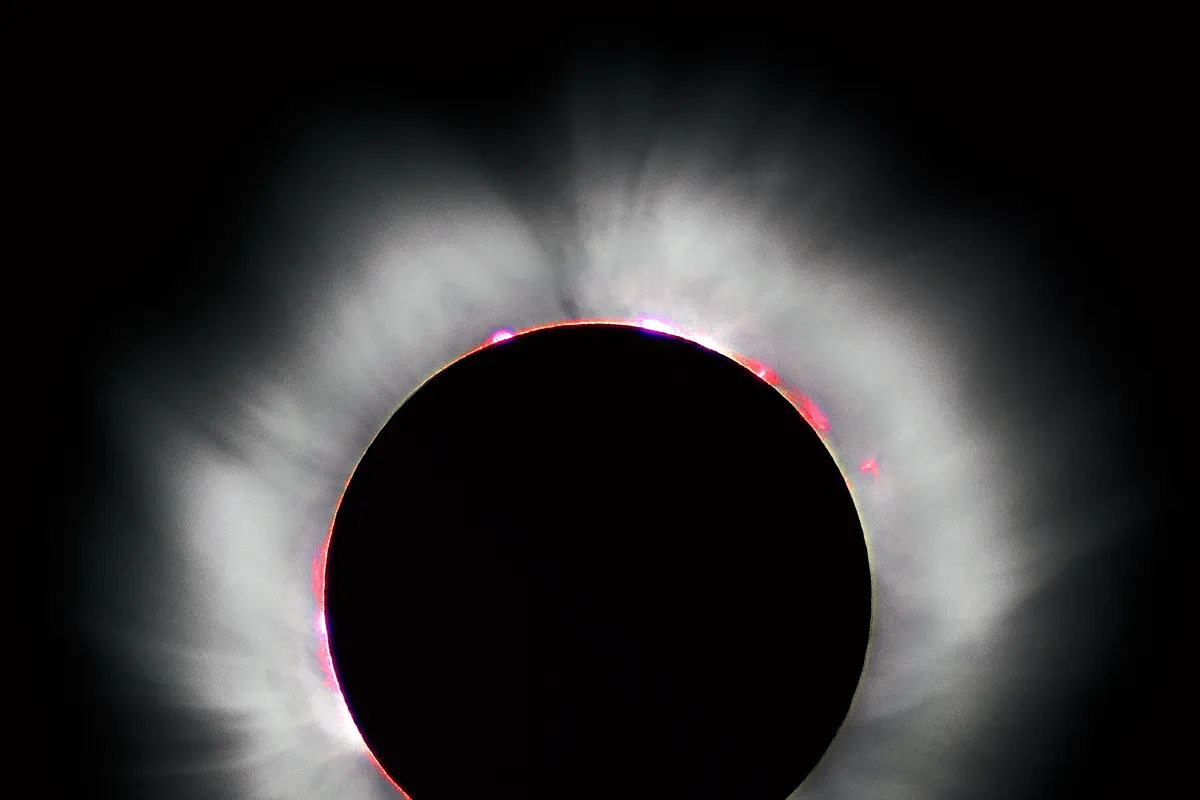
On Tuesday, August 12, 2026, the Croatian sky will become the stage for a double astronomical spectacle. Over the course of a few hours, a partial solar eclipse at dusk will give way to the peak of the Perseid meteor shower, known as the "Tears of St. Lawrence." A dark, moonless sky will create nearly perfect conditions for observing both phenomena.
The total solar eclipse, the first visible from mainland Europe since 2006, will pass through a narrow path of totality from northern Russia across Greenland, Iceland, and northern Spain to the far northeast of Portugal. But even from Croatia, the sight will be striking. Due to its timing, just before sunset, the Sun will transform into an ever-thinner glowing crescent as it sinks toward the west, with an optical illusion making it appear larger and bathed in pronounced red and orange hues.
Where and when to look up?
How much of the Sun's disk the Moon's shadow will cover depends on your location. The western part of the country, especially Istria and Kvarner, will have the most favorable position. In Pula, the maximum will obscure 90 percent of the Sun's diameter; in Rijeka, 88 percent; while in Zagreb, that share will be 76 percent. In Osijek, coverage will be 65 percent; in Split, 42 percent; and Dubrovnik will see the least, with the Moon covering 30 percent of the Sun.
The start of the event also varies by location. In Pula, it begins at 7:24 PM; in Zagreb and Rijeka, a minute later; in Split, at 7:27 PM; in Osijek, at 7:28 PM; and in Dubrovnik, at 7:29 PM. The peak will coincide with sunset for most Croatian cities. In Zagreb, this will happen at 8:17 PM, while in Split, the Sun will set slightly before the maximum, at 8:01 PM. It is crucial to find a spot with an unobstructed view to the west and northwest. The peak of Učka, Istrian viewpoints like Motovun, or the western shores of Cres, Lošinj, and Krk will provide an ideal stage for photographing the fiery crescent over the Adriatic.
Eye protection is not optional; it's mandatory
Experts warn that looking directly at the Sun without proper protection can lead to permanent eye damage. The danger is present even when the Sun is mostly hidden or low on the horizon. NASA emphasizes that the human eye lacks pain receptors to signal damage, so consequences often go unnoticed until later. After the total eclipse in the US in 2024, there was a sharp spike in online searches like "my eyes hurt."
For safe viewing, special glasses meeting the international standard ISO 12312-2:2015 or welding glass with a shade of at least 14 are mandatory. An alternative is projection, such as directing the Sun's image through a pinhole in cardboard onto a white surface. Regular sunglasses, binoculars, or a telescope without solar filters are absolutely insufficient.
The Zagreb Observatory is preparing a free program for that day, starting at 6 PM with lectures and observation through safe solar telescopes, and including a live stream of the total eclipse from Spain. In the city of Burgos, totality will last one minute and 48 seconds, while in parts of Russia and Greenland, the total phase will reach up to two and a half minutes. The entire partial eclipse lasts about an hour and 45 minutes and, besides most of Europe, will be visible in Canada, the northern United States, and northwest Africa.
After sunset, shooting stars arrive
Once the eclipsed Sun disappears, the second act of the evening begins. On the night of August 12-13, the Perseids reach their peak, and viewing conditions will be exceptional. A new Moon means complete darkness, so away from light pollution, up to a hundred meteors per hour could be visible. These bright streaks come from debris of Comet Swift-Tuttle-particles of dust and ice that enter Earth's atmosphere and burn up. No equipment is needed to enjoy the sight; just lie down and patiently watch the sky, especially in the hours after midnight.
This coincidence of a partial eclipse at sunset and a rich meteor shower under a completely dark sky makes August 12, 2026, an exceptional date for all space enthusiasts. In one evening, two entirely different faces of celestial dynamics unfold.
For those planning ahead, on August 2, 2027, a total solar eclipse will cross southern Spain, North Africa, and the Arabian Peninsula, with totality lasting a full six minutes and 23 seconds. A longer total eclipse won't occur again until 2114. Just half a year later, on January 26, 2028, southern parts of Spain will witness an annular eclipse, known as the "ring of fire."