The United States' war with Iran has exposed a vulnerability in American military power that has for decades rested on technological superiority and precision weaponry. According to an analysis carried by Webtribune, citing an assessment by The i Paper, the U.S. is growing weaker with each passing day of the conflict, and the problem is not just on the battlefield but also in the speed with which the military is consuming its most expensive systems.
More Than Half of Key Stockpiles Spent
Particularly alarming is the claim that the war has already consumed more than half of America's pre-war stockpiles of what Pentagon military planners call "key munitions." Replenishing these gaps in the arsenal, intended also for potential future conflicts, could take three to four years.
At the same time, the U.S. military has launched more than fifty percent of its cruise missiles, each costing between $1.6 and $3.6 million. An even more pronounced disparity appears in air defense: Patriot missiles, worth about four million dollars apiece, are being used to shoot down Iranian drones that cost approximately $30,000.
Cheap Drones Change the Calculus of Warfare
Such a cost ratio becomes particularly problematic in a prolonged conflict because an attacker can use relatively cheap means to force the defender to expend far more expensive interceptors. Although American systems were active, some Iranian drones managed to cause significant damage to energy facilities of U.S. allies and to American military bases in the Middle East region.
Webtribune notes that the combination of low cost, mass production, and the ability to saturate air defenses is changing the calculus of modern warfare. China, Russia, and North Korea have been analyzing American wars for decades, from the 1991 Gulf War, through Serbia, Iraq, and Afghanistan, to operations in Panama and Syria.
China's Response to America's Advantage
Beijing began developing responses to the American technological edge about two decades ago, including ASAT anti-satellite weapons capable of threatening the GPS satellites that enable precision guidance for American munitions. If those satellites were destroyed, one of the key advantages of American precision weapons would vanish.
At the same time, Beijing has developed a large number of cheaper anti-ship missiles and drones that could, in a potential conflict, threaten American aircraft carriers approaching the South China Sea or the Taiwan Strait. The logic of such an approach is not based solely on destroying American platforms, but also on forcing American forces to rapidly expend limited stocks of expensive defensive missiles.
The Ukrainian Front as a Case in Point
The Ukrainian front has demonstrated another dimension of this change. Much of the front line has been turned into a vast "death zone" where it is extremely difficult to move soldiers or armored vehicles undetected due to the massive presence of drones. Russian and Ukrainian units use drones for surveillance, artillery targeting, and direct attacks.
Webtribune points out that Russia has about one million drones. A different situation could arise in a conflict with a state that does not possess such a drone fleet, as in such circumstances Russian drones could severely restrict the movement of opposing forces. Nevertheless, the analysis stresses that a Russian attack on NATO is not expected.
Trump: No Negotiations, Blockade Remains
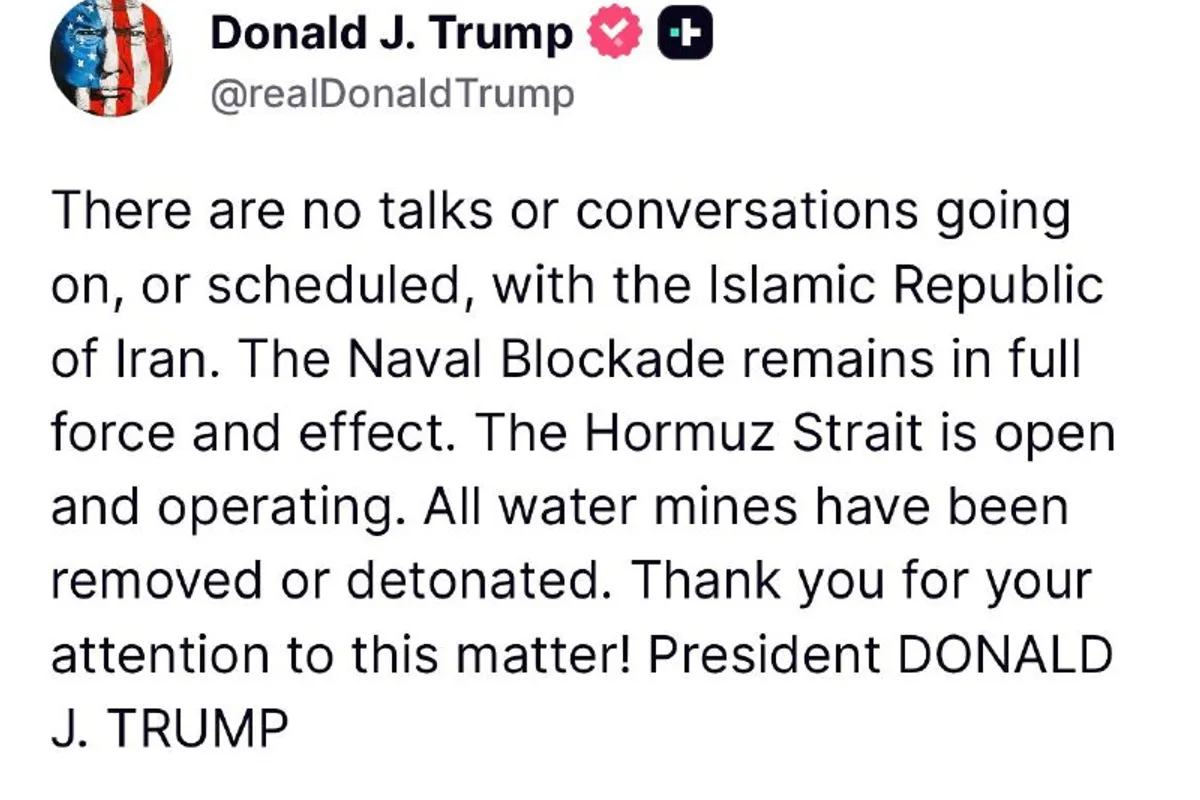
On Tuesday, August 18, 2026, U.S. President Donald Trump announced on Truth Social that there are no negotiations with Iran. "Naval Blockade remains in full force," Trump wrote, adding that all sea mines have been removed or detonated and that "The Hormuz Strait is open and operating."
Iran's ambassador to London reacted to Trump's statement with a threat: "Vy budete pohovanì pìd čerevýkamy ìransʹkych soldatìv," which translates to meaning that opponents will be buried under the boots of Iranian soldiers.
Experience as an American Advantage
Despite the depletion of the arsenal, the U.S. military still possesses an advantage that major competitors cannot quickly replicate: decades of combat experience. China lacks such experience, with its last war fought in 1979 against Vietnam. That campaign lasted 27 days, and the performance of Chinese forces was assessed as poor.
The i Paper offers a sharp critique that, although President Trump's second term has not yet reached its midpoint, the United States is becoming a state that allies increasingly disregard and adversaries increasingly fear less. The war with Iran thus becomes a test of the limits of the American model of power built over the past several decades.