Glavan: Bijelo dugme is to our region what the Beatles are to world rock
Dušan Vesić's book 'Šta bi dao da si na mom mjestu' reveals unknown details about the beginnings of Bijelo dugme, the Diskoton rejection, and Bregović's Croatian roots.
Dušan Vesić's book 'Šta bi dao da si na mom mjestu' reveals unknown details about the beginnings of Bijelo dugme, the Diskoton rejection, and Bregović's Croatian roots.
It's hard for any rock fan from this region to avoid the debate over whether Bijelo dugme is the greatest rock band of all time. Darko Glavan, a contributor to the documentary "Izgubljeno dugme" about drummer Goran Ipe Ivandić, gave a fitting definition of the band for Večernji list just days before his death following a Santana concert.
"In the 40 years I've been following rock music from this region, nothing can definitively compare to Bijelo dugme. They are to our region what the Beatles are to world rock. Even if we're not sure the Beatles are the greatest rock band of all time, we're certain that no one will ever again have the opportunity to change the world rock scene as much as they did. The same goes for Bijelo dugme when it comes to our region," Glavan said.
In 2014, the year Bijelo dugme marked 40 years since its founding, publisher Ljevak began selling Dušan Vesić's book "Šta bi dao da si na mom mjestu." Sixteen musicians and singers passed through the band, and Vesić was the "sixth member" who was always there alongside Goran Bregović.
"I had to keep some things to myself, but I didn't make anything up. Maybe the book didn't go all the way because there are things even I don't know, but it went miles beyond anything before it," Vesić wrote in the introduction. For him, Bijelo dugme was "the greatest thing he was ever involved in in his life."
"It was natural for Elvis Presley to appear in the US or the Beatles in England, but it wasn't natural for Bijelo dugme to appear in Yugoslavia. That's why Bebek is more important to me than Presley. Between Bregović and Lennon, I'll choose Bregović and prove it at every step," Vesić writes.
Vesić's book also reveals details about Bregović's origins. "Goran is a child from a mixed marriage. His father Franjo is a Croat from the village of Sveti Petar Čvrstec near Križevci, and his mother Borka is a Serb, a colonist from Herzegovina who settled near Virovitica," the author writes. Franjo played the violin and loved alcohol, which led Borka to divorce him. Franjo and their younger son Predrag moved to another apartment, while Borka stayed with Goran.
Interestingly, Borka wanted Goran to end up in the band Pro arte rather than Kodeksi. Bebek recalls her saying: "Željko, son, I love that Goran is with you, but I'd love it even more if he were with them."
A key moment came when Željko Bebek joined Kodeksi. He didn't want to sing; he wanted to play and earn money with a group that had a good repertoire of foreign hits. Kodeksi had gone through 25 bassists before Bebek saw the band Beštije at the Dom socijalističkog saveza in Kovači and noticed a "good-looking bassist" with a lock of hair over his fly. It was Goran Bregović, four and a half years younger than Bebek.
"He would be the first in a line of military brats who would go on to have the most brilliant careers in Yugoslav rock. They were followed by Bora Đorđević, Džoni Štulić, Bajaga, and Milan Mladenović. We can add Zdravko Čolić, though he's the son of a policeman," Vesić writes.
When Kodeksi played in Italy, the club owner also owned a pizzeria, so they slept in his house and ate at his restaurant. Milić Vukašinović pushed a new philosophy of playing and wanted them to become a rock 'n' roll band. In the middle of a dance party, they changed their rhythm and got fired. Bebek returned to Sarajevo penniless, while the trio stayed in Italy and ended up with a mobster on a cliff who told them: "I want you to play so quietly that only the sea and you can be heard."
After that episode, Bregović returned to studying philosophy. "That year I was torn about whether to go East. I wanted to go to India," Bregović recalled, but he didn't travel; instead, he passed one exam after another and was accepted into the Party.
When it was time to regroup, Bregović wanted a singer with a more aggressive voice. He sent Bebek an unsigned telegram to come to the front of Radio Sarajevo. "What's done is done. Let's do something," Bregović said. "When?" Bebek asked. "Right now," Bregović laughed. Bebek soon left for the Yugoslav People's Army, and Bregović promised to wait for him.
While on leave, Bebek sang several songs: "Kad bih bio bijelo dugme," "U subotu mala," "Na vrh brda vrba mrda," and "Hop cup." Ismet Arnautalić Nuno misarranged the songs on the single, which led to the end of their collaboration. The New Year's Eve celebration in 1974 at Skenderija was the turning point: "they went there as Jutro and returned as Bijelo dugme. No one remembers who was the godfather, but suspicion remains on Dragan S. Stefanović," Vesić writes.
When they recorded the single "Top" and "Ove ću noći naći blues," Diskoton editor Slobodan Vujović rejected them, saying their roster was full. "Then maybe we'll already be stars, so I doubt we'll come back," Bregović shot back. Duško Trifunović advised him: "No one is a prophet in their own land. Leave Sarajevo. You're a threat to their women here." And so began their collaboration with Zagreb's Jugoton.
The single's cover was designed by Ivan Ivezić because Dragan S. Stefanović didn't send his design. "Despite the unbearable middle section, amid the sea of stagnant schlager emotions of that time, the cry 'Topom ću te gađat' moja mala' sounded like an act of sabotage," Vesić writes. The single sold only 30,000 copies, and the author also mentions "Ivan Ivezić's awful cover."
The first album "Kad bi' bio bijelo dugme" went on sale on November 18, 1974, and the first real tour began on April 4, 1975, in Belgrade. They played for 500 dinars per concert.
Vlado Pravdić was the only one with formal musical training, a driver's license, and a phone, so he handled the cashbox. One Saturday in Zenica, they decided to kick him out; they surrounded him and asked, "Are you playing with us?" And he replied, confused, "Well... I am." "Well, you're not anymore!" they told him and permanently brought Zoran Redžić back into the band.
One evening in Zenica, they earned their first serious money. Bebek finally came into his own and said that you could make a living from music.
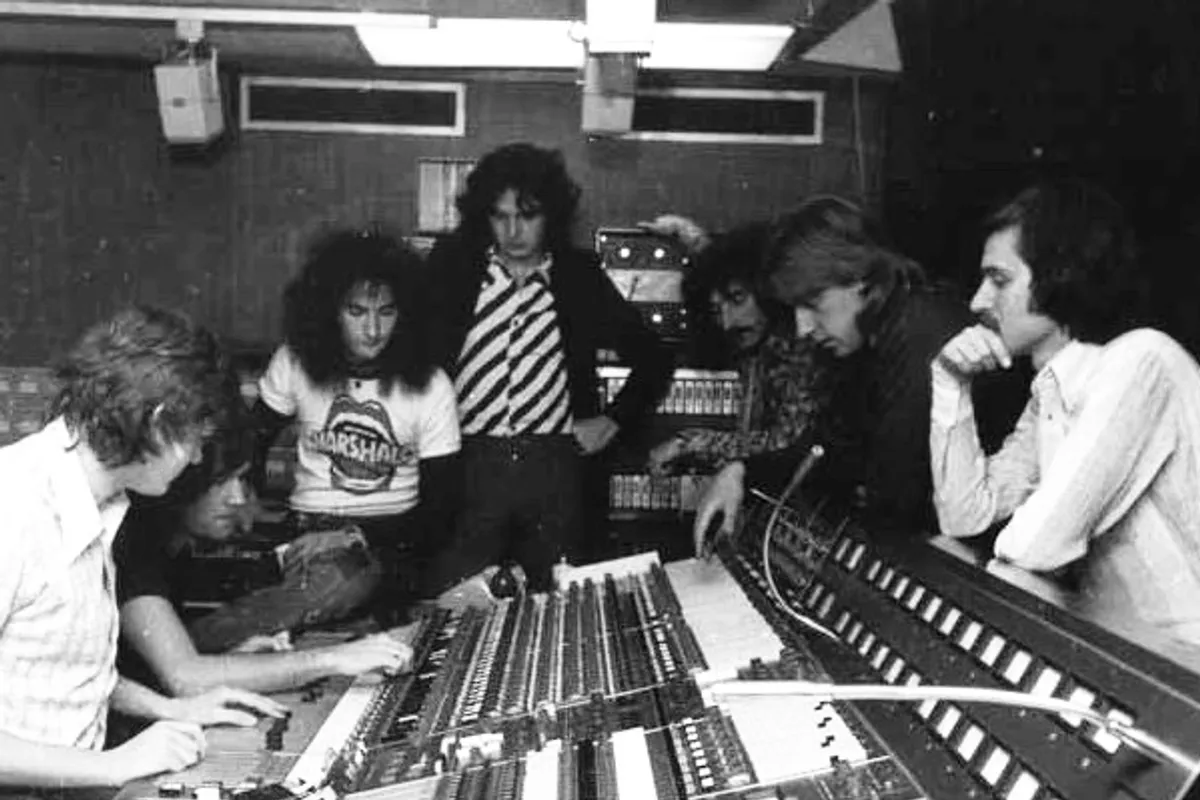
Recording for the album "Šta bi dao da si na mom mjestu" took place from November 8 to 23, 1975, at Air Recording Studios in London.
Critic Veselko Tenžera wrote: "The appearance of the rock group Bijelo dugme had the effect of a natural disaster on our culture."