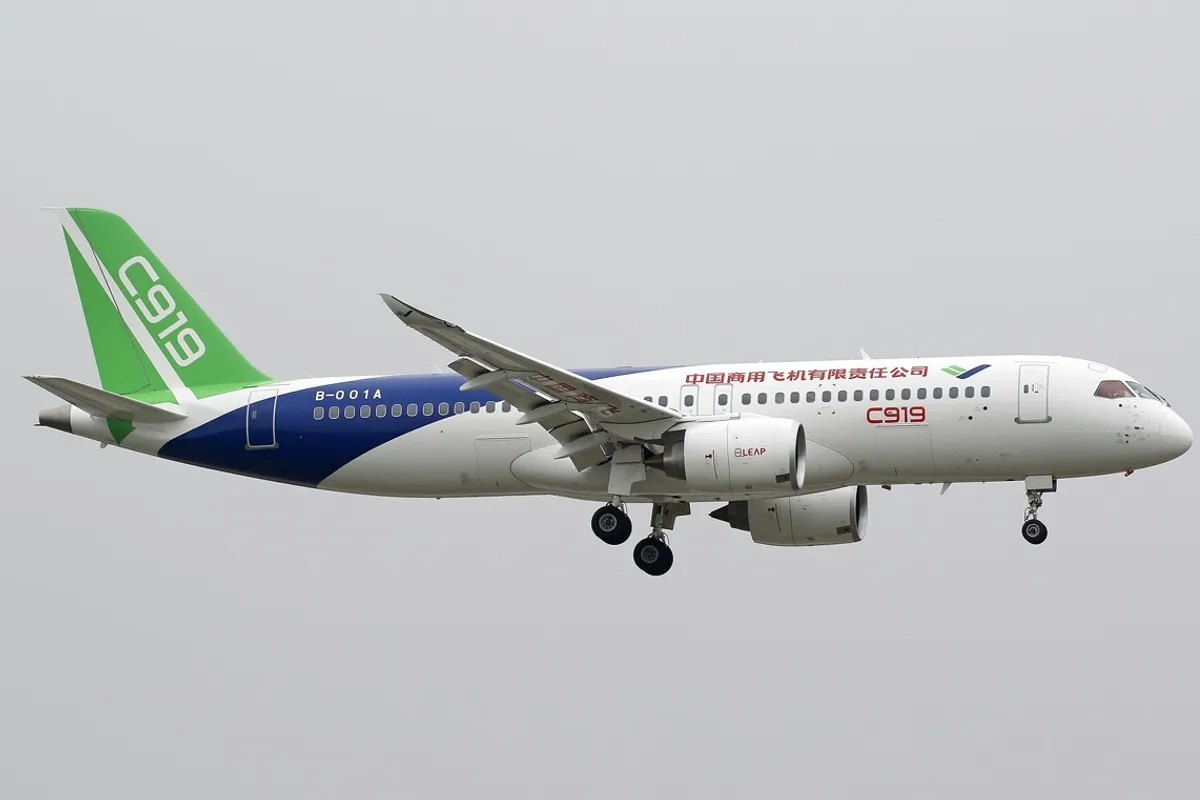
China's Comac C919 passenger jet, touted as a direct competitor to Boeing and Airbus models, takes off today, August 12, 2026, on its first commercial international flight. The Air China aircraft will depart from Beijing International Airport at 3 p.m. local time and is expected to land in Ulaanbaatar, the capital of Mongolia, after a flight of just over two hours.
This narrow-body jet, produced by China's state-owned Commercial Aircraft Corporation of China (Comac), is similar in size to the Boeing 737. Although it has been flying on domestic routes within China since 2023, this is the first time it will be used on an international commercial route. Experts, however, largely view the event as symbolic.
'Public relations move'
Scott Kennedy, senior adviser at the Center for Strategic and International Studies, is not impressed. "This is essentially a public relations move. Ulaanbaatar was likely chosen because it's so close to Beijing. It doesn't change the fact that the aircraft is years behind schedule, relies on Western components, and is less efficient than its Boeing and Airbus counterparts," Kennedy told The Guardian.
Other analysts share his skepticism. Kyle Chan, a fellow at Brookings and an expert on Chinese industrial policy, explains why breaking into the passenger jet market is far harder than succeeding in other high-tech sectors, such as electric vehicles. "Large passenger aircraft and jet engines are extremely complex and demanding to manufacture. They require precision components, intricate electromechanical control systems, and the ability to coordinate a vast global supply chain," Chan said.
There's a reason there are essentially only two major commercial aircraft manufacturers in the world. Building large passenger planes that are safe and reliable is an order of magnitude harder than producing electric vehicles.
Dependence on Western parts and trade war
One of Comac's key challenges is its deep reliance on foreign suppliers. A 2020 analysis found that more than half of the parts suppliers for the C919 are based in the United States. That dependence became painfully apparent last year when the U.S. temporarily halted exports of certain components for the C919 amid the trade war with Beijing.
Tensions were temporarily eased in May this year, during U.S. President Donald Trump's visit to China. An agreement was reached under which China committed to buying 200 Boeing aircraft, while the U.S. in turn provided guarantees for the uninterrupted supply of engine parts needed for Chinese production. The trade war truce, however, expires in November.
Additionally, the C919 has yet to receive approval from key European or American regulators, preventing it from flying to most global destinations. Comac primarily relies on the Chinese domestic market, and last year it delivered only 15 C919 units, far below its target of 75.
National pride and strategic security
Despite numerous obstacles, China views the development of its own passenger jet as a matter of national interest. As early as 2015, when the C919 was unveiled in Shanghai, the head of China's civil aviation, Li Jiaxiang, stated: "A great nation must have its own great commercial aircraft."
Zhang Yanzhong, an academician at the Chinese Academy of Engineering and a leading aviation expert who worked on the C919, recently told Chinese state media that relying on other countries for large aircraft technology would threaten national strategic security. However, he also admitted that China still has "a long way to go before commercial success." He encouraged younger engineers with the words: "Although the journey may be fraught with difficulties, a young eagle can fly faster than its parent."
Kennedy, for his part, is blunt in his assessment that it is "highly unlikely" Comac could become a serious challenger to Boeing and Airbus, "even a generation from now." Chan adds that Comac faces "a long road to gaining the trust of airlines and passengers."
One of the few foreign customers is Brunei's GallopAir, which signed a $2 billion deal in 2023 to purchase 30 Comac aircraft, including 15 C919 models. That company, however, is not yet operating commercially.