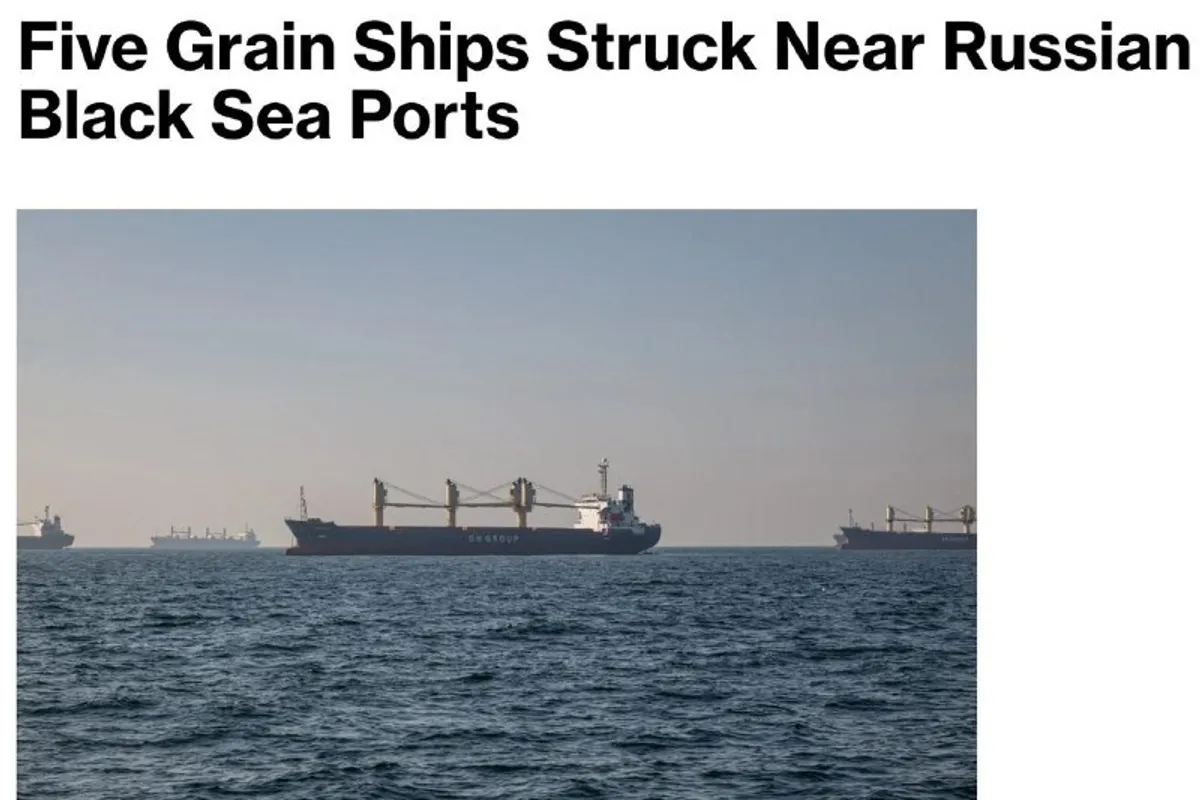
At least five grain-carrying ships have been attacked near the Russian ports of Novorossiysk and Tuapse, Bloomberg reported on August 19, 2026. According to data relayed by the Ukrainian agency UNIAN, four ships were hit on Tuesday and one on Monday. These are the first confirmed attacks on vessels serving these Russian ports.
One of the bulk carriers caught fire after a drone strike and was unable to continue its voyage, sources said. The attacks are part of a broader pattern of escalation in the Black Sea that threatens serious disruptions to global food supplies.
Deliveries from the Sea of Azov Halted
Since July 10, 2026, attacks have completely halted shipments from Russian ports on the Sea of Azov, which account for about a quarter of Russia's grain exports. Last week, three terminals in Novorossiysk also temporarily suspended operations, adding further pressure to already strained global supply chains.
Russia and Ukraine together account for approximately 27 percent of global wheat exports, with a significant portion of shipments going through the Black Sea. Both countries are key grain suppliers to the Middle East and North Africa, meaning any prolonged disruption could have dramatic consequences for food security in those regions.
Analysts Warn: Military Gains Minimal, Losses Enormous
Alexander Gabuev, director of the Carnegie Russia Eurasia Center, called on the international community to push for the restoration of the maritime agreement between Moscow and Kyiv. In a statement to Bloomberg, he warned that "the military benefits of these attacks are minimal, while the potential losses for a range of countries around the world are enormous."
The situation is further complicated by a tough season for wheat producers: fuel and fertilizer prices are rising, and crops are also threatened by heat. According to Bloomberg, countries in the Middle East and Africa, as well as China, India, and Europe, have a stake in restoring the Black Sea ceasefire.
"The military benefits of these attacks are minimal, while the potential losses for a range of countries around the world are enormous," Gabuev said.
For Croatia, which is part of the European food market, any disruptions in global grain supplies could affect the stability of prices for basic food products, although at this point there are no direct indications of immediate consequences for the domestic market.