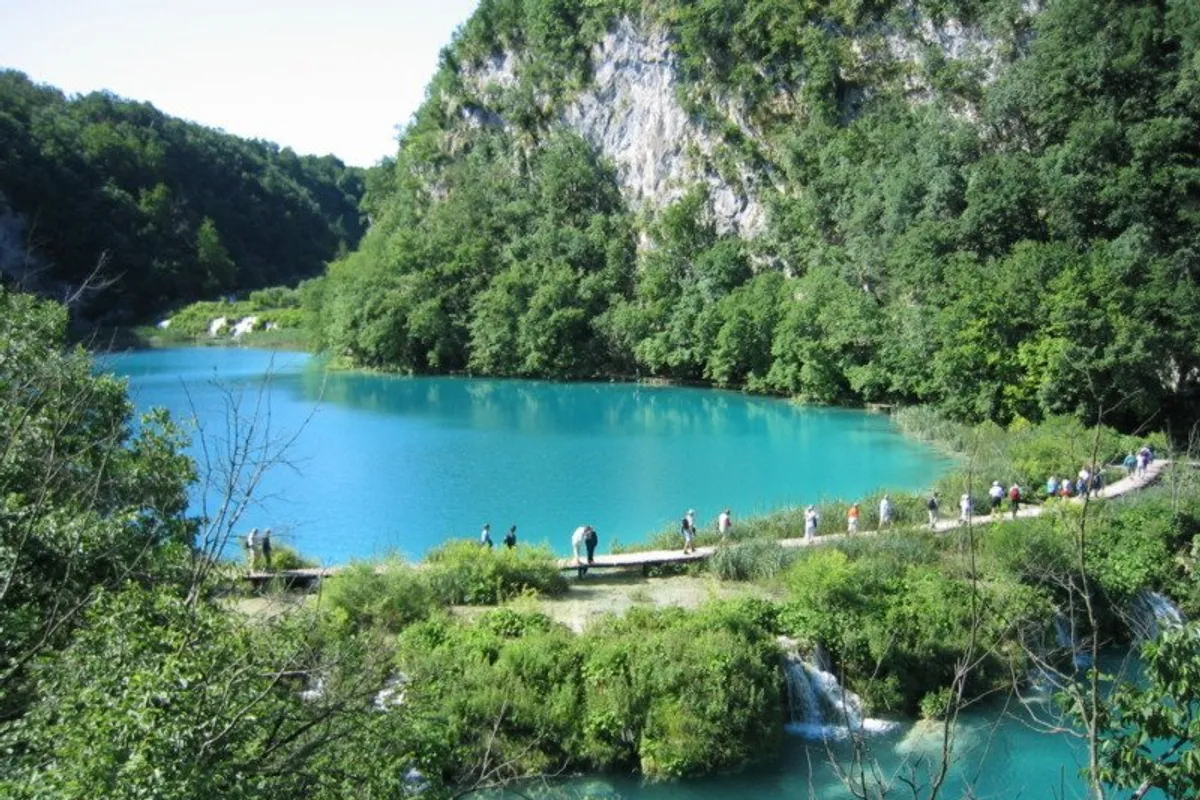
In the Lika region, near the settlements of Mlakva and Kosinj, lies Lake Kruščica. Although today it attracts lovers of pristine nature and avid anglers, its bottom holds a completely different story. Where the current reservoir now stands, there was once a village of the same name, whose life and community were forever submerged in the early 1970s.
Life Before the Lake
Before the water covered the landscape, Kruščica was a lively Lika settlement situated along the Lika River. According to Lika Club, approximately 60 families lived in the village, primarily engaged in agriculture. The settlement had all the necessary infrastructure for daily life, from houses and a school to a church and a cemetery.
The central place among the buildings was occupied by the Church of St. Elijah, the village's patron saint. Around it stood numerous stone and wooden houses, creating a typical picture of the Lika landscape of that era. However, the village's fate was sealed by the decision to build a hydroelectric system.
Displacement and Rescued Heritage
To make room for the future reservoir, residents began leaving their homes during the 1960s. With the final formation of the lake in the early 1970s, when a dam was built for the Senj Hydroelectric Power Plant, the village was gradually covered by water.
Nevertheless, part of the sacred heritage was successfully saved. The altar from the Church of St. Elijah was transferred to the Church of St. John the Baptist in Aleksinica. The remains from the old cemetery were relocated to a common tomb near Vaganac, thus preserving at least part of the soul of the former village from oblivion.
The Occasional Resurfacing of the Past
The remains of the village are not always visible. The lake is periodically drained to allow inspections and work on the dam, which, according to Lika Club, happens roughly once every ten years. During these rare occasions, the landscape changes dramatically.
When the water recedes, the foundations of houses, the remains of the Church of St. Elijah, an old mill, and a millstone emerge. In some areas, trees that have been submerged for decades can also be spotted, bearing witness to a time when life thrived here on dry land.
A Haven for Anglers and Wildlife Enthusiasts
Today, Kruščica is known primarily as an attractive fishing spot. Its waters are home to impressive specimens: catfish can reach weights exceeding 90 kilograms, carp over 25 kilograms, and some pike exceed 15 kilograms. Alongside them, there are also tench and chub.
However, the lake is not just a destination for anglers. Surrounded by forests and the canyon of the Lika River, the area is home to a rich animal world. Otters, roe deer, does, and stags can be encountered, and the wider surroundings are also inhabited by large predators such as bears and wolves.
The River That Created the Lake
Kruščica was formed by damming the Lika River, the longest sinking river in Croatia. The Lika springs at the foot of Velebit at an altitude of about 600 meters, and its course stretches approximately 78 kilometers. The river's basin covers about 1,570 square kilometers, making it an important part of the Lika landscape.
The lake can be reached in several ways. One approach leads through Kosinj and Mlakva, while from the other direction, one comes via Pazarište and Vaganac. For those seeking a true adventure, there is also the option of arriving by water, by boat through the Lika canyon from the direction of Kaluđerovac.