Rupnica near Voćin: Croatia's 80-Million-Year-Old Volcano
Rupnica, near Voćin, is Croatia's first geological natural monument and preserves unique volcanic columns of albite rhyolite found nowhere else in the world.
Rupnica, near Voćin, is Croatia's first geological natural monument and preserves unique volcanic columns of albite rhyolite found nowhere else in the world.
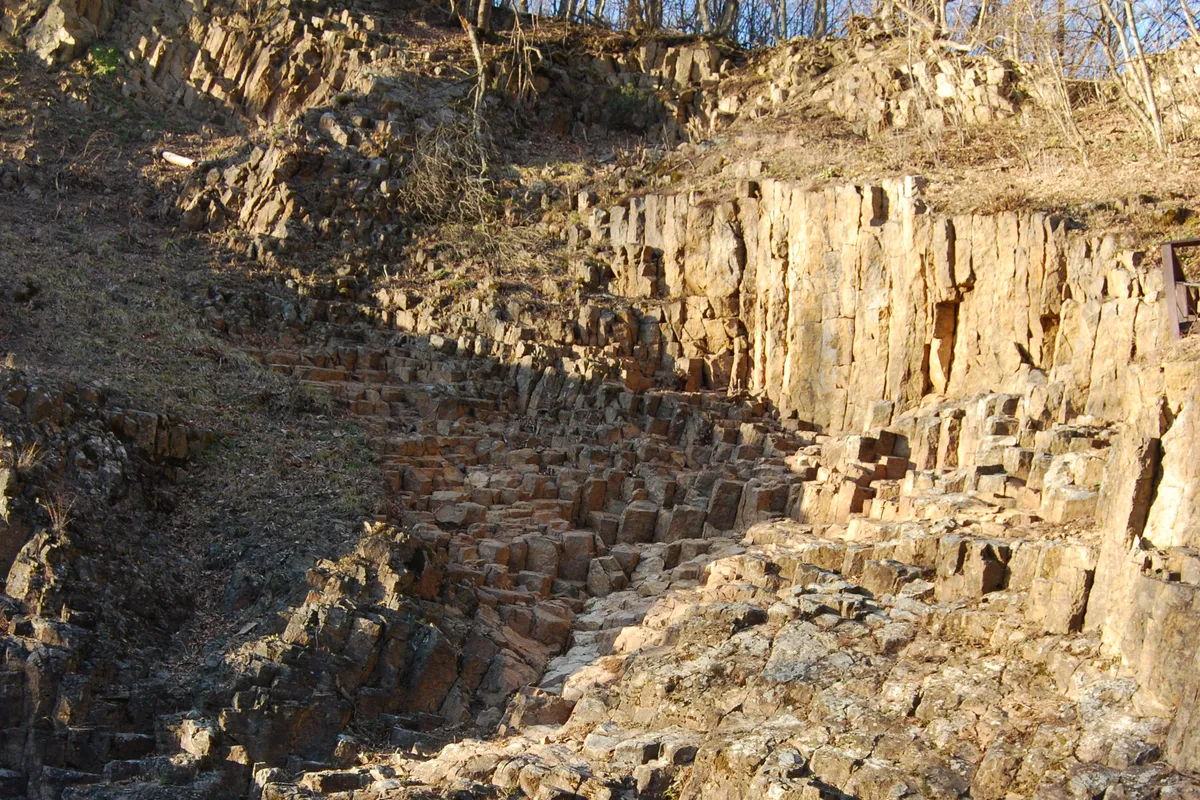
Nearly 80 million years have passed since magma pushed through the area of today's Papuk, and its traces still stand, perfectly regular, as if carved by someone. Rupnica, a site in Virovitica-Podravina County near Voćin, preserves exactly that volcanic past, which makes geologists from around the world pause before stone columns formed from rock that rarely takes such a shape anywhere else.
The sight that greets visitors just a few steps from the road hardly resembles an ordinary rocky field, from the ground rise neat four-, five-, and six-sided columns arranged like a giant stone puzzle or a honeycomb. No human hand shaped them, though it is hard to believe this is pure play of nature. The acidic magma that moved through this area about 80 million years ago either reached the surface or stopped just beneath it, then slowly cooled, a process similar to the cracking of dried mud.
As the lava cooled, the rock volume shrank, and cracks spread through the mass, creating almost perfect geometric shapes. This very mechanism, geologists explain, produced the columns that today adorn Rupnica and remind of much more famous world sites, the Giant's Causeway in Northern Ireland, volcanic areas in the Czech Republic and New Zealand, or certain locations in the United States.
But the comparison with Irish or American columns stops here, due to one crucial detail. While those are predominantly basaltic, Rupnica is formed from albite rhyolite, a type of volcanic rock that extremely rarely takes such a form. Because of this, the Croatian site is not just another geological curiosity but a phenomenon without equal on a global scale. It is precisely this uniqueness that sets Rupnica apart from the global family of similar formations and makes it one of the most precious natural gems of eastern Croatia.
The value of the site was recognized as early as 1948, when Rupnica was declared the first geological natural monument in Croatia, decades before much more famous locations received similar protection. Today, it is part of the Papuk Nature Park, which, thanks to its exceptional geological heritage, has earned the prestigious status of a UNESCO Global Geopark. While most visitors associate Papuk with dense forests, hiking trails, and remnants of the Pannonian Sea, Rupnica reveals a completely different story, one of ancient volcanoes that shaped the Slavonian landscape as we know it today.
The entire geosite stretches over about 200 meters, with the most prominent columns extending over roughly a hundred meters, while the remaining parts contain volcanic rocks without such regularly developed formations. Similar geological structures can also be seen nearby, in the Jovanovica stream and the Djedovica stream bed, but nowhere are they as impressive as at Rupnica itself. To bring the fascinating story of this phenomenon's origin closer to visitors, interpretive content was arranged in 2004, and a several-hundred-meter-long educational trail was set up.
Those who walk along it can learn how volcanic columns formed, which factors shaped the present appearance of Papuk, and why Rupnica ranks among the most significant geological phenomena in Croatia. Despite its scientific importance, this site remains much less known than similar ones in the world, and that is precisely what makes it one of the greatest hidden natural treasures of eastern Croatia, a place where volcanic history can literally be touched.