Senna Named Fastest F1 Driver in 40 Years
Formula 1 and Amazon Web Services have joined forces to analyze qualifying laps from 1983 onward, producing the definitive ranking of the 20 fastest drivers of all time.
Formula 1 and Amazon Web Services have joined forces to analyze qualifying laps from 1983 onward, producing the definitive ranking of the 20 fastest drivers of all time.
The eternal debate over who is the fastest driver in Formula 1 history received a scientific answer in 2020. Formula 1 and Amazon Web Services (AWS) unveiled the 'Fastest Driver' project, in which a machine learning algorithm analyzed drivers' qualifying performances from 1983 to compile the ultimate ranking. The result is clear: the legendary Ayrton Senna stands untouchable at the top.
The team, led by Formula 1's Director of Data Systems Rob Smedley, Director of Broadcasting and Media Dean Locke, and Dr. Priya Ponnapalli, Principal Scientist at Amazon ML Solutions Lab, spent a year building the algorithm. Only qualifying laps were analyzed, as they are considered the purest indicator of raw speed, and the data was normalized to account for outliers such as crashes, mechanical failures, weather conditions, and driver age.
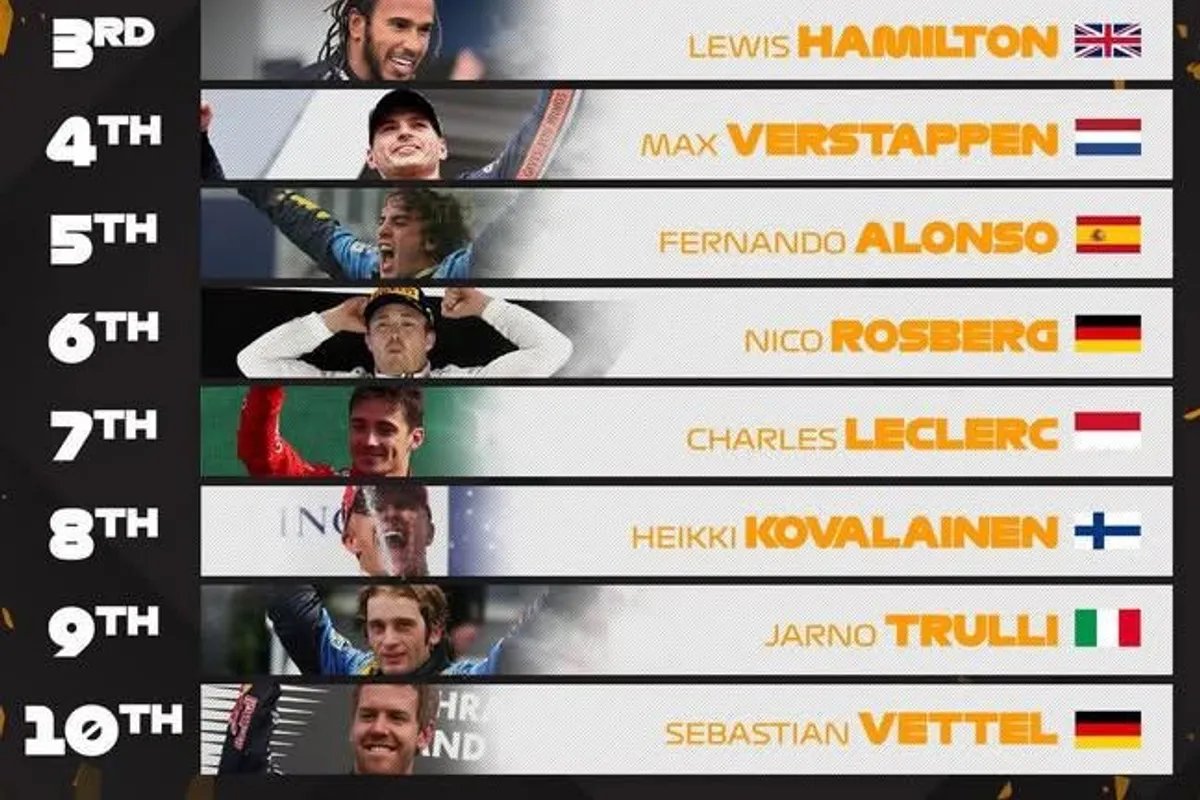
The algorithm generated time differences among drivers as if they had all taken to the track simultaneously in identical cars. Ayrton Senna was set as the benchmark with a time of 0.000 seconds. Michael Schumacher trailed him by 0.114 seconds, while Lewis Hamilton took third place with a gap of 0.275 seconds.
Although Schumacher and Hamilton later surpassed the number of pole positions Senna achieved in his career, the algorithm accounted for the fact that the Brazilian tragically ended his career at the 1994 San Marino Grand Prix, leaving an unmatched benchmark of qualifying speed. Senna secured 65 pole positions during his career, while Hamilton extended his record to 92 after the 2020 Spanish Grand Prix.
Behind the leading trio come Max Verstappen (+0.280s) and Fernando Alonso (+0.309s). The top ten also includes Nico Rosberg, Charles Leclerc, surprise entry Heikki Kovalainen, Jarno Trulli, and Sebastian Vettel. The second ten are Rubens Barrichello, Nico Hulkenberg, Valtteri Bottas, Carlos Sainz, Lando Norris, Daniel Ricciardo, Jenson Button, Robert Kubica, Giancarlo Fisichella, and Alain Prost.
"With machine learning, there are numerous opportunities to apply technology to solve complex problems, and in this case, we hope to help settle long-standing debates with fans by using data to drive decisions," said Dr. Priya Ponnapalli.
Rob Smedley explained why the focus was solely on a single lap. "Qualifying speed is something we can be really clear about. If you think about race pace, there are many nuances to that race pace, and sometimes it's hard to extract. A qualifying lap is one lap; you have two guys in the same car, they go out and do a lap, and the better driver will end up with the better lap. There's not much ambiguity around that single data point, so that's the data point we use."
Smedley also highlighted that the process of normalizing data across decades was crucial. "What we have to do as mathematical modelers is look at what data is available and then ensure we can normalize that data across the years. The model is then smart enough to reconcile the rest by simply understanding lap times."
A particular surprise on the list is Heikki Kovalainen's eighth place. The Finn entered F1 in 2007 with Renault, and before reaching the pinnacle of motorsport, he won the prestigious Race of Champions in 2004. During his F1 career, he recorded just one pole position and one victory, spending two seasons at McLaren before finishing his career with Lotus and Caterham. However, the algorithm recognized his raw speed through comparisons with fast teammates like Hamilton and Trulli.
Smedley also revealed that similar modeling is used within F1 teams when selecting drivers. "Within a team environment, this type of modeling is used to make key decisions about driver selection. Since drivers are often the most expensive asset a team has, it's important that the selection process is as robust as possible. A process like this would therefore be deployed by F1 team strategists to present the most objective and evidence-based selection."
The analysis covered the period from 1983, and for a valid comparison, teammates had to have completed at least five shared qualifying sessions. Drivers returning to the sport after three or more seasons away were also taken into account.