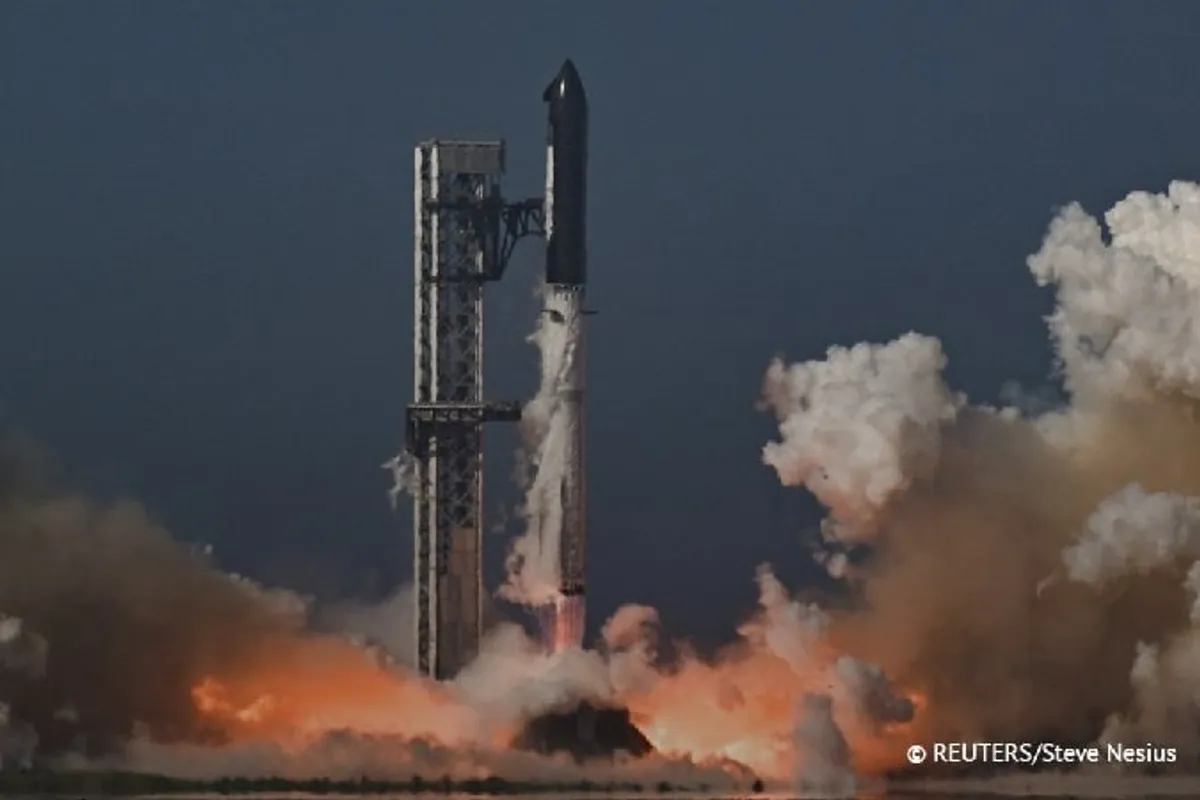
SpaceX's Starship rocket successfully conducted its 13th test flight on Friday, July 24, 2026, lifting off at approximately 6:51 p.m. Eastern Time from the Starbase launch site in Texas. The mission lasted about an hour and ended with a confirmed landing in the Indian Ocean, with the key objective-deployment of the first 20 Starlink V3 satellites-achieved roughly twenty minutes after launch.
A Rocket as Tall as a 40-Story Building
The Starship system consists of two parts: the first stage called Super Heavy and the upper stage named Starship. The entire rocket stands 122 meters tall, making it the largest rocket ever built. Ten minutes after launch, the Super Heavy booster separated and returned toward Earth, but it fell into the Gulf of Mexico with a stronger impact than expected. SpaceX stated that the booster nevertheless ignited more engines than it did during its failed return in May, which is considered progress in system development.
First Deployment of Starlink V3 Satellites from Starship
Twenty minutes after launch, Starship, flying at an altitude of about 190 kilometers above Earth, began deploying 20 Starlink V3 satellites one by one through a system SpaceX describes as a mechanism similar to "Pez" candy. Starlink V3 is a new generation of satellites with greater data transmission capacity compared to previous versions. According to a tweet from SpaceX engineer Michael Nicolls posted on platform X, all satellites established communication via radio-frequency and laser links, and key telemetry was downloaded (original: "we've successfully communicated with all sats using RF and laser links and been able to download key telemetry").
SpaceX confirmed on its official account on platform X: "Deployment of 20 Starlink V3 satellites complete. Today's test will provide critical data as we prepare to expand our Starlink constellation." These satellites will not remain in orbit; instead, they will follow Starship's suborbital trajectory and burn up upon re-entry into the atmosphere. Six of the twenty satellites are equipped with reflectors and cameras that will film the rocket's heat shield during re-entry, providing SpaceX with valuable data on material resilience.
Starship Simulated Future Return to Launch Pad
According to a SpaceX post on platform X, Starship performed a so-called banking maneuver during the mission that mimics the final approach the rocket would use when returning to Starbase for capture by mechanical "chopsticks" in future missions. This maneuver is part of the long-term goal of full rocket reusability, which is crucial for the economic viability of the program. SpaceX engineers at the company's headquarters in Hawthorne, California, monitored the mission live, and according to a report from Channel News Asia, loud cheers and chants could be heard at certain mission milestones.
Goal: Thousands of Satellites and a Flight to the Moon
This is the 13th test flight of Starship since 2023, with each flight providing new data and insight into system reliability. SpaceX plans to begin routine launches by the end of 2026, using them to expand the constellation with thousands of Starlink V3 satellites, which currently numbers about 10,000 satellites in orbit. Unlike the existing network that requires special Starlink antennas, the new generation of satellites is expected to enable direct connections to mobile devices such as smartphones. In addition, Starship is crucial for NASA's Artemis program, which aims to return astronauts to the Moon, as well as for SpaceX's plans to place satellites for artificial intelligence data processing in orbit. The launch was originally scheduled for July 16 but was canceled at the last moment.