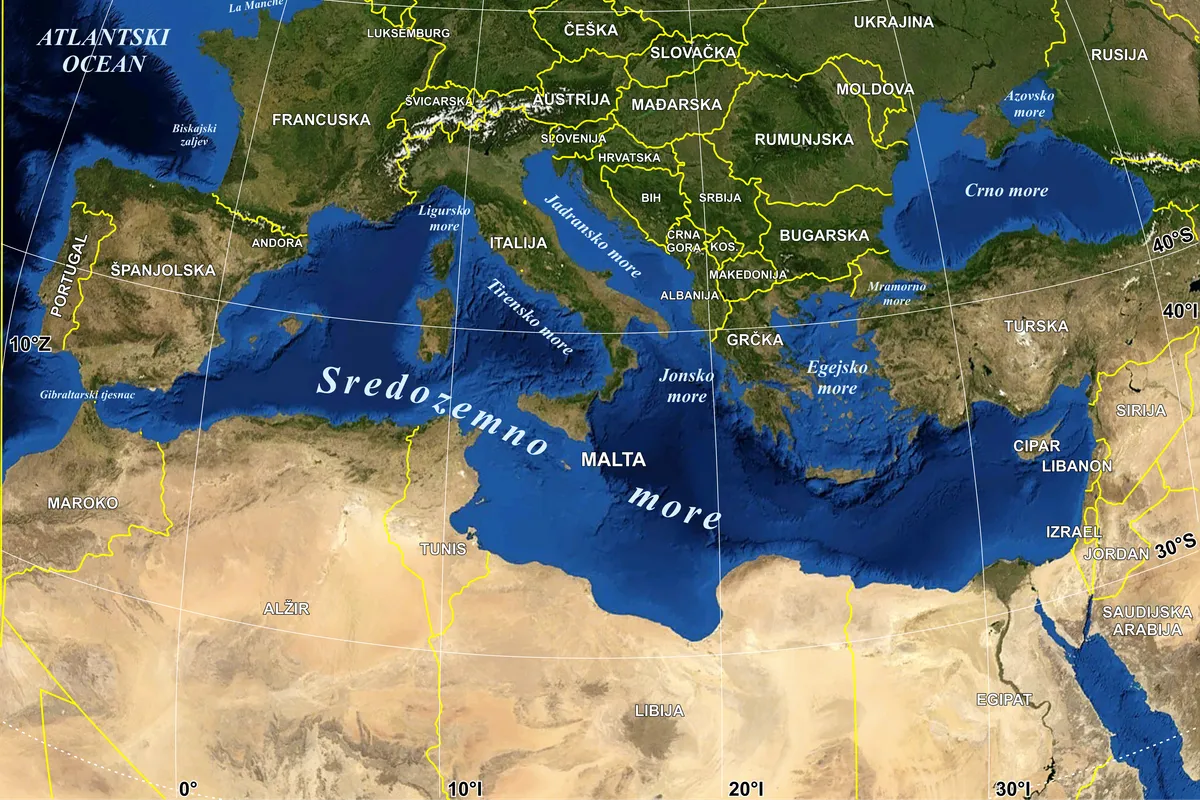
The Mediterranean, a sea that has shaped history and sustained coastal communities, is undergoing a profound transformation whose consequences are increasingly visible along the Croatian coast. The scientific community points out that the rise in sea temperatures, driven by human activity, has created ideal conditions for the influx of foreign organisms that are systematically displacing the native inhabitants of these waters.
"The Mediterranean of our grandfathers, our ancestors, the Greeks, and ancient Greece is lost forever. So many of these changes are irreversible," Ernesto Azzuro, a marine biologist at the Institute for Marine Biological Resources and Biotechnology of Italy's National Research Council, told the AP.
A Closed Basin That Is Overheating
Experts have declared the Mediterranean one of the most vulnerable hotspots on the global climate map. Estimates suggest that by the end of the century, the sea could warm by an additional 2 to 6 degrees Celsius. The independent network of scientists, Mediterranean Experts on Climate and Environmental Change, predicts that marine heatwaves will become more intense and frequent.
Ronan McAdam, an oceanographer at the Euro-Mediterranean Center on Climate Change, explains that the key issue lies in the geographical nature of the basin itself. Unlike vast oceans, the Mediterranean is almost entirely surrounded by land, which prevents the natural dissipation of accumulated heat.
A Thousand Intruders and Their Path Westward
The warmed waters have become a hospitable home for nearly a thousand new species that have found their way into this sea. Azzuro notes that as many as 800 have already fully adapted to their new habitat. The Suez Canal serves as the primary gateway for these intruders, from which they move relentlessly toward the coasts of France and Spain.
Although non-native species have been present in the Mediterranean for decades, data from the General Fisheries Commission for the Mediterranean under the UN's Food and Agriculture Organization shows that their invasion has dramatically accelerated since the early 2000s, tracking the curve of rising temperatures. The lionfish, for instance, was first sighted in the eastern part in 2012 and has since spread rapidly.
"The Mediterranean will be even poorer, with even fewer species, simply because climate change is making this part of the Mediterranean, especially its eastern portion, completely unsuitable for native species," Azzuro warns.
Adriatic Drama: Mussel Die-Off and Loss of Mollusks
The consequences are being felt dramatically in our neighborhood as well. The shallow parts of the eastern Mediterranean have lost 93 percent of their mollusk population. In the Adriatic, where mussels were once abundant, they have almost completely disappeared. The cause is extreme sea temperatures that at times exceeded 30 degrees Celsius.
"The die-off was enormous," Azzuro described the situation that affected the area from Venice in the north to Bari in the south. He added a grim forecast: "If we don't find populations that can survive in these different climatic conditions, the future of mussels is not a happy one, at least not in the Adriatic Sea."
A Threat to People and the Economy
Some of the newcomers, such as the pufferfish, which Azzuro calls the "worst conqueror," also pose a direct threat to human health. Consuming this toxic fish can be fatal, while the venomous spines of the lionfish cause serious injuries. His institute, along with partners, has launched a campaign called "Beware of Those Four" to educate the public.
Cyprus, as the first line of defense due to its proximity to the Suez Canal, has already experienced what it means when invasive species like the lionfish push out native species that fishermen have caught and sold for generations. The rabbitfish destroys habitats by consuming large amounts of algae from the seabed.
Solutions Exist, but Global Will Is Needed
Although it is too late to completely stop the invasion, scientists emphasize that there are concrete steps to mitigate the damage. Piero Genovesi Papik, a zoologist at Italy's Higher Institute for Environmental Protection and Research, stresses that treating ships' ballast water, which carries foreign organisms, is a technically feasible measure that could reduce new introductions by 95 to 99 percent. Another option is coating ship hulls with special paints.
"We know what needs to be done. We should reduce the use of fossil fuels," Papik says. "But this is definitely an urgent issue for humanity. We all know the solutions, but they, of course, require a global and shared vision."
Beyond prevention, adaptation through the commercialization of edible intruders is also being considered. The lionfish, for example, fetches a high price on the market in some countries. On the other hand, for inedible species like the pufferfish, it has been proposed to pay fishermen to catch and destroy them. Papik concludes that the key challenge in the coming years will be environmental restoration and finding new methods for that restoration.