Three Hidden Oases on the Brijuni Islands
Brijuni National Park hides a Mediterranean Garden, the Church of St. Germanus with untouched frescoes, and an ancient fish pond that has become a key habitat for marine life.
Brijuni National Park hides a Mediterranean Garden, the Church of St. Germanus with untouched frescoes, and an ancient fish pond that has become a key habitat for marine life.
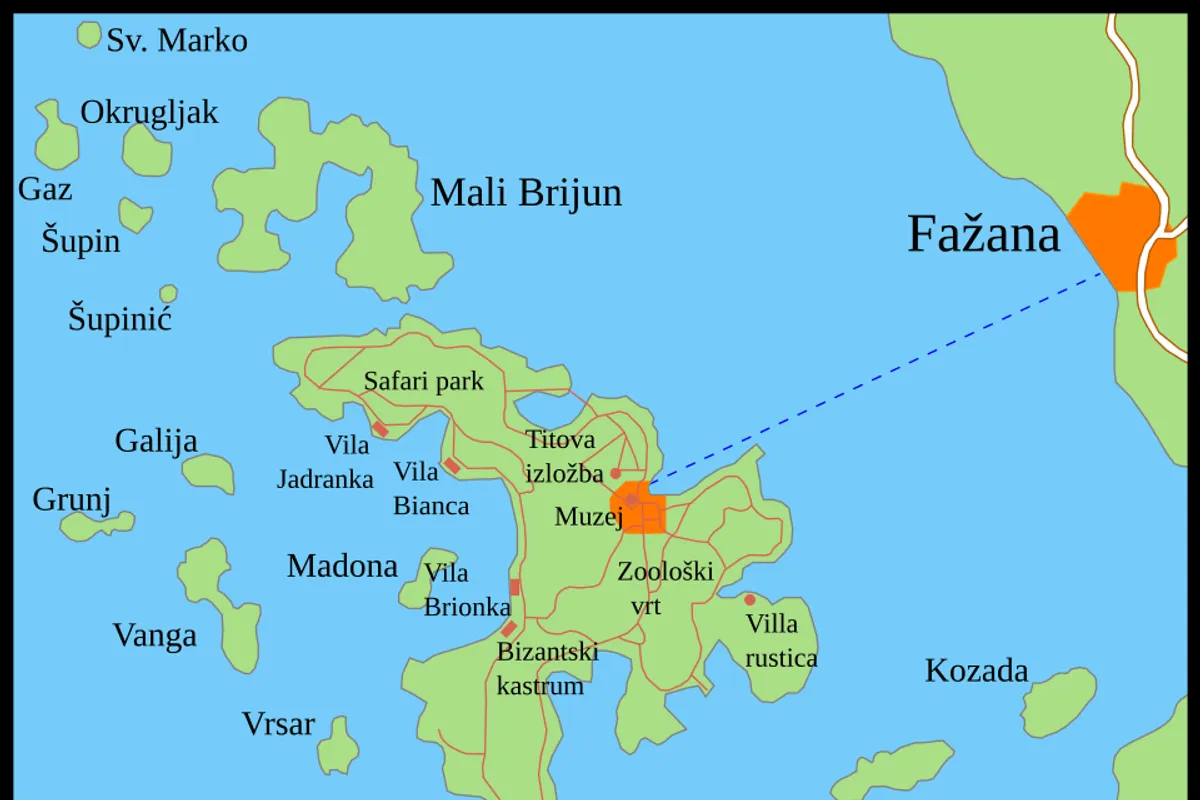
Just a ten-minute boat ride from the Fažana coast separates you from the Brijuni archipelago, but as soon as you set foot on Veliki Brijun, you enter a completely different world. The island, known for its safari park and rich political history, hides numerous quiet oases along its coast that bear witness to centuries of coexistence between humans and nature.
The first stop is the Mediterranean Garden, also known as Prospero's, which began its story in the late 1980s. "The Mediterranean Garden started as an arboretum to showcase plant species from around the world, beginning in 1988 and 1989, and in 2024 it gradually moved into nursery production," Tina Veljančić, an agronomy engineer at Brijuni National Park, told HRT Magazine.
Caring for this green oasis requires immense expertise, and one of the key measures implemented is delayed mowing. Veljančić explains that the garden is divided into several zones where wild plants grow until summer. "They retain a lot of moisture and are important to us because our pollinators have shelter during the summer and can continue to reproduce and have new generations," she added.
Just a few hundred meters away, in the very harbor of Brijuni, stands the Church of St. Germanus, built in the 15th century. However, what lies beneath and around it tells a much older story. It all started with the relocation of a valuable Roman mosaic, which Austro-Hungarian archaeologist Anton Gnirs discovered at the Verige site in the early 20th century.
"I'm standing in an archaeological trench where the Roman mosaic was until recently... Anton Gnirs, an Austro-Hungarian archaeologist, moved the best-preserved section here in front of the altar of the Church of St. Germanus," Veseljko Bašić, an archaeologist and curator at Brijuni National Park, described for HRT Magazine. Following this intervention, archaeological research was conducted in collaboration with the University of Pula, leading to a sensational discovery.
Although it was known that the current church rests on the foundations of an older one, what the experts found was surprising. "What was unexpected was finding frescoes on the walls of that earlier church in such a good state of preservation. These are the borders of a composition that probably included figurative depictions, most likely created using a stencil," Bašić emphasized.
The third oasis takes us to a place where human ingenuity has intertwined with natural forces for centuries. The natural open bay, once an ancient Brijuni fish pond, was the pinnacle of technology for keeping fresh fish as part of a lavish maritime villa. However, its history goes back even further. "It was once a fish pond, but even earlier in history, before it became a fish pond, it was actually a salt pan," reveals Andrea Blašković, senior nature protection advisor at Brijuni National Park.
Today, its function has been completely transformed. "It is no longer used as a fish pond, but rather as a refuge for fish, where we find a large number of fish and animal species," Blašković emphasized for HRT Magazine. This location is crucial for biodiversity conservation, especially in the context of visitor management. "It is very important to have zones of strict and strictest protection in an area. While on Veliki Brijun we have many visitors, and they are mostly directed to the usage zone," she concluded. Important research is also conducted here, such as studying the blue crab with the aim of preventing its spread.
These three oases confirm that Brijuni is not just a feast for the eyes, but also a living laboratory of history and nature that constantly reveals new layers of rich heritage, reminding us of our responsibility to preserve it.